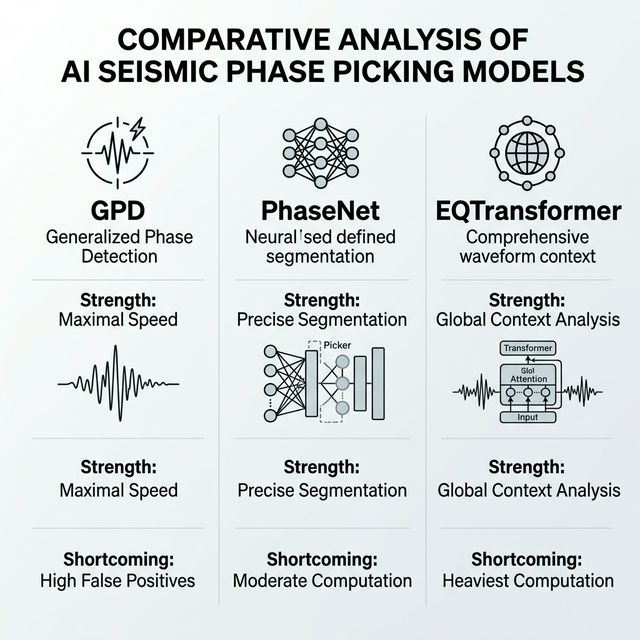
The deployment of deep learning models for automated seismic phase picking has fundamentally changed observational seismology. By rapidly identifying P-waves and S-waves in continuous waveform streams, these AI tools enable the construction of massive, high-resolution earthquake catalogs that were previously impossible to assemble manually. Among the most popular architectures deployed in real-world seismic networks are Generalized Phase Detection (GPD), PhaseNet, and EQTransformer. While PhaseNet and EQTransformer have largely become the gold standards for precision, GPD retains a significant structural advantage: raw computational speed. However, deploying GPD in real-world, highly dense networks reveals a critical operational trade-off centering on false positive generation.
The Architecture and Training of GPD
GPD was designed with simplicity and rapid inference in mind. It treats seismic phase identification as a straightforward window classification problem. In its original training configuration, GPD evaluates discrete 4-second windows of seismic data sampled at 100 Hz (yielding 400 data points per channel).
Unlike its successors that output continuous probability distributions across
a sliding time series, GPD is trained on discrete labels formatted as a simple
hard-coded vector—such as [1, 0, 0] for a P-wave,
[0, 1, 0] for an S-wave, or [0, 0, 1] for pure
noise. The model examines a specific 4-second chunk of data and rigidly
classifies the entire window into one of these three distinct categories.
The Speed Advantage
Because GPD relies on evaluating these discrete, non-overlapping or lightly sliding windows with a relatively shallow convolutional architecture, it is incredibly fast. Among the "big three" deep learning pickers, GPD boasts the lowest inference latency and requires the least computational overhead. This makes it an attractive candidate for massive retrospective catalog processing where millions of hours of archive data must be scanned, or for deployment on resource-constrained edge devices. GPD will churn through waveforms significantly faster than the dense UNet architecture of PhaseNet or the heavy attention mechanisms of EQTransformer.
The False Positive Trade-Off and "Over-Picking"
The speed of GPD comes at a steep cost when applied to continuous, noisy, real-world data. Because GPD was trained on discrete 4-second windows labeled in simple vector forms, it lacks the broader contextual awareness of the waveform surrounding that snapshot.
In practice, when scanning a continuous seismic trace, GPD exhibits a strong tendency to over-pick. A single, complex physical arrival (such as a messy P-wave with a long coda or scattered energy) may span multiple consecutive windows depending on the sliding step size. Because the model independently assesses each window, it often fires multiple positive classifications in rapid succession for what is physically just one event. Furthermore, some transient noise that resembles a phase arrival within a 4-second vacuum will trigger a positive classification as well.
The result is an abundance of false positives compared to PhaseNet and EQTransformer. If you deploy GPD on an active trace, the good news is that it will have high capability to pick every legitimate true positive present. The bad news is that these true positives will be buried underneath a large volume of incorrect or redundant picks. By contrast, PhaseNet produces a continuous probability distribution over the waveform to pinpoint the precise sample index of the phase onset (avoiding redundant triggers), and EQTransformer uses self-attention to understand the global context of the station's full trace, leading to significantly cleaner, singular outputs for each arrival.
The Limitations of Fine-Tuning
A common strategy to improve a deep learning model's performance on a specific local network is transfer learning or fine-tuning. Researchers often take the base GPD model and retrain it on a regional dataset of manually verified local earthquakes to suppress noise and improve accuracy.
However, my empirical deployment shows that fine-tuning GPD does not fundamentally resolve the false positive issue. While fine-tuning might help the model learn the specific frequency content of local regional noise, it cannot fix the structural limitation of the architecture itself. The 4-second windowing approach and vector-based classification dictate that GPD will continue to over-pick the sample length of a trace.
Ultimately, GPD remains a powerful tool when computational speed is the absolute primary constraint and network analysts possess robust downstream association algorithms capable of aggressively filtering out thousands of false picks. But when precision, clean catalogs, and low false alarm rates are necessary, the architectural constraints of GPD make PhaseNet and EQTransformer the vastly superior choices, despite their computationally heavier footprints.
Be the first to respond.