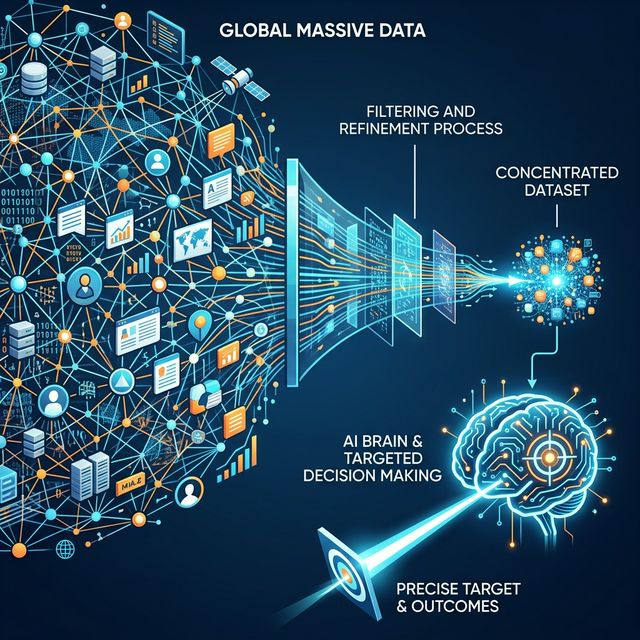
In the broader field of artificial intelligence, the prevailing narrative is almost unanimously "bigger is better." The most celebrated advances involve foundation models trained on unimaginable volumes of data. This trend aggressively permeated seismology, leading to the creation of massive, generalized deep learning models trained on global waveform libraries containing millions of earthquake traces, such as the STEAD or INSTANCE datasets. While these generalized "off-the-shelf" models display impressive baseline capabilities, their deployment on specific, regional networks often uncovers a frustrating reality: generalized knowledge struggles to cleanly parse highly localized noise.
The Local Deployment Gap
Every seismic network has its own distinct signature. A network monitoring induced seismicity in a fractured sedimentary basin deals with fundamentally different scattering, attenuation, and anthropogenic noise (like drilling or heavy machinery) than a network deployed on a volcanic edifice or across a massive craton. When an off-the-shelf model—trained predominantly on standard tectonic earthquakes from California or Japan—is deployed into these unique environments, performance can degrade significantly. The model may mischaracterize local quarry blasts as earthquakes or fail to identify highly attenuated P-waves unique to the region's velocity structure.
Historically, the assumption was that overcoming this performance gap required the arduous task of building a local dataset on par with the massive global ones—a prospect requiring years of manual, expert annotation. Fortunately, my deployment experience reveals a very different, highly encouraging reality.
The Power of a "Few Thousand" Traces
Through my deployment experience, a clear and consistent empirical observation has emerged: you do not need millions, or even tens of thousands, of traces to adapt a robust foundation model. In fact, a small, highly curated dataset of just a couple of thousand traces is typically entirely sufficient to drastically improve the performance of an off-the-shelf picker like PhaseNet or EQTransformer on a local network.
Why does such a small dataset yield such disproportionate returns through transfer learning and fine-tuning? The answer lies in what the model already knows. The massive, generalized pre-training phase has already taught the neural network the fundamental physics of seismology—it inherently "understands" the broad frequency bands of body waves, polarization, and the general envelope shapes of seismic energy.
When you introduce a couple thousand local, expert-labeled traces during fine-tuning, you are not teaching the model what an earthquake is from scratch. Instead, you are simply shifting its internal decision boundaries to accommodate the idiosyncratic noise profile and specific structural attenuation of your regional deployment. The neural network quickly learns to ignore the local sawmill's vibrations and tune into the distinct high-frequency snap of your local micro-seismicity.
The Immense Value of Curated Regional Datasets
This dynamic fundamentally shifts how network operators should view data curation. It transforms the overwhelming prospect of "big data" into a highly achievable goal of "smart data." Especially for smaller networks or network with limited resources, this is great news. A few thousand high-quality, expert-labeled traces are actually achievable for most networks. In workload terms, this is a manageable task for a single person or a small team over a few weeks or months.
The key insight is that for regional adaptation, the value of data is found in its relevance, not its volume. While "Big Data" is the engine of foundation models, it is often a practical impossibility for regional networks constrained by limited funding and manpower. However, this is not merely a compromise born of necessity; it is a strategic pivot. Because a few thousand curated traces are technically sufficient to capture local nuances, the "unachievability" of a massive corpus ceases to be a barrier to entry.
There is incredible, outsized value in smaller, meticulously curated datasets. For effective fine-tuning, this is the low hanging fruit. A few thousand perfect, human-verified examples of difficult local noise and subtle physical arrivals represent the ultimate skeleton key for local AI adaptation. By focusing resources on the dense, high-quality annotation of a relatively small catalog rather than shotgunning millions of low-quality automated labels, regional networks can construct highly efficient fine-tuning assets.
As the deep learning ecosystem for seismology matures, the bottleneck will no longer be algorithm design or access to raw compute. The true differentiator for precision monitoring will be these small, high-value regional datasets—the crucial final mile that takes a generalized algorithm and sharpens it into an expert local analyst.
Be the first to respond.