The MQTT (Message Queuing Telemetry Transport) protocol is fundamentally not designed for sophistication. It was designed for strict survival. Originally created in the late 1990s by IBM and Eurotech for monitoring a remote oil pipeline over fragile, painfully slow satellite links, every single byte sent over MQTT cost money. Connections dropped frequently and without warning. That arduous origin story explains almost everything about why it became the absolute default protocol for IoT sensor networks decades later, dominating spaces from smart homes to industrial monitoring.
In remote scientific deployments—such as field-deployed seismic sensor networks in harsh environments—those exact same constraints apply today. A remote observation station running entirely on solar power with a weak cellular or LoRa uplink simply cannot afford the massive overhead of HTTP headers or the complex handshakes of WebSockets for every waveform packet. It desperately needs a protocol that maintains persistent sessions natively, delivers messages asynchronously, and keeps the packet header at a microscopic 2 bytes of fixed overhead.
The Architecture of Decoupling: Publish-Subscribe
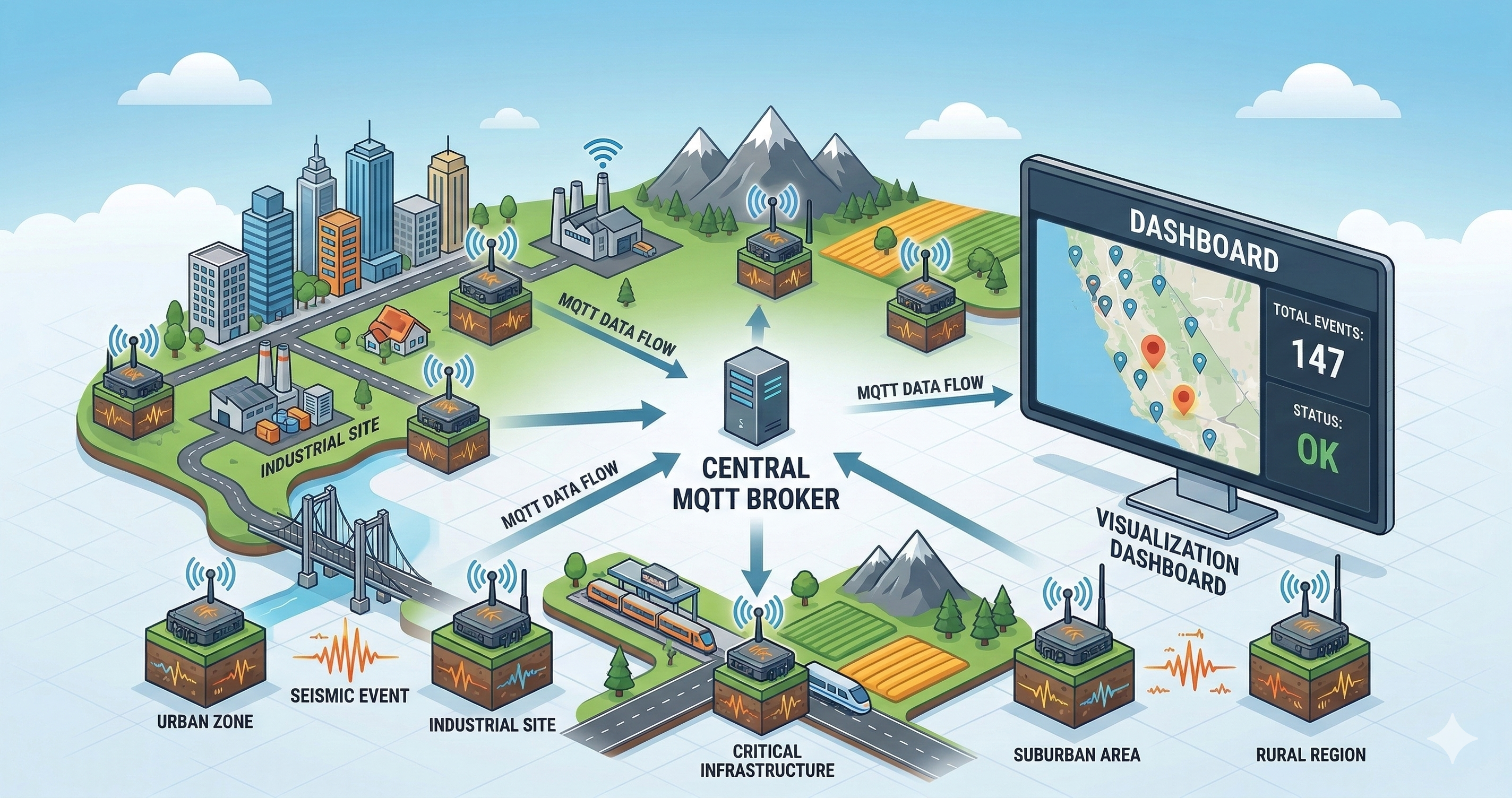
MQTT’s publish-subscribe (pub/sub) model is architecturally distinct from the request-response pattern (like HTTP REST) that most web developers default to. In MQTT, Publishers (e.g., the field sensors) emit messages on named "topics" without knowing or caring who is listening. Subscribers (e.g., data aggregation dashboards, ringservers, automated alert systems) receive those messages by subscribing to specific topics, without ever knowing who sent them.
The central MQTT Broker sits between every publisher and subscriber, completely decoupling them in both time and space. A new subscriber can join the network at any point and—using features like Retained Messages—instantly receive the last known state of a sensor without waiting for the next explicit broadcast.
This decoupling provides massive architectural flexibility. If a sensor node goes offline, the dashboard doesn't crash trying to connect to a dead IP address; it simply stops receiving messages from the broker. If a new analytics microservice needs raw data, you don't need to reprogram the remote sensor to send data to a new server; the microservice simply connects to the broker and subscribes to the existing topic.
Topic Hierarchies: The Taxonomy of Data
MQTT topics are modeled like file system paths, allowing for elegant,
structured data routing. A seismic array might publish to a topic structure
like array_alpha/station_01/sensor_Z/waveform.
Subscribers can use wildcards to filter data brilliantly. Subscribing to
array_alpha/+/+/waveform allows a single ingestion microservice
to receive waveform data from every sensor on every station
within `array_alpha`. Subscribing to array_alpha/# subscribes to
absolutely every metric, heartbeat, and waveform generated by the entire
array. This wildcard system pushes the burden of message routing entirely onto
the broker, keeping the client code radically simple and lightweight.
Quality of Service (QoS) Levels
MQTT’s three explicit Quality of Service (QoS) levels — at-most-once (QoS 0), at-least-once (QoS 1), and exactly-once (QoS 2) — give system designers granular control over the reliability-overhead tradeoff on a per-message basis.
For raw, high-frequency seismic waveform streaming—where a sensor might be pushing 100 samples per second—QoS 0 is almost always appropriate. The data is a continuous firehose, and dropping occasional packets over a spotty connection is far preferable to the massive latency and memory overhead required to buffer and retransmit every dropped sample. However, for a critical earthquake detection alert triggered by edge ML inference, QoS 1 or 2 ensures the alert message gets through exactly as intended, even if the connection hiccups natively during the broadcast.
Designing for Failure: Last Will and Testament
One of the most elegant features of MQTT for remote networks is the
Last Will and Testament (LWT). When a sensor connects to the
broker, it registers an LWT message (e.g., a payload of
"OFFLINE" on the topic station_01/status).
If the sensor disconnects ungracefully—due to battery death, a wildfire, or a cellular blackout—the broker realizes the connection has dropped abruptly and automatically publishes the LWT message to all subscribers. The dashboard immediately reflects the sensor as offline, and alert systems can notify technicians, all without the dying sensor needing to somehow gasp a final death-rattle message over a broken network.
MQTT in the Seismic Stack
In my current sensor architecture, the ESP32 microcontroller edge node publishes continuously encoded waveform packets on a highly structured topic hierarchy identical to the one described above. A dedicated Python subscriber running on a secure cloud instance catches these topics and forwards qualifying detection events to an FDSN-compliant ringserver. Simultaneously, a lightweight WebSocket client running in the browser feeds the live earthquake tracker dashboard in real time directly from the broker.
MQTT serves as the universal, decoupled message bus that allows all these disparate consumers to evolve completely independently, without ever modifying the delicate C++ firmware running on the low-power sensor.
The result is a remarkably flexible, resilient, and future-proof stack. New consumers — whether they are alert SMS gateways, cold-storage cloud archiving systems, or heavy ML inference endpoints doing secondary signal validation — can be added seamlessly by simply subscribing to the existing data streams, operating safely out of band of the critical telemetry infrastructure.
Be the first to respond.